Be human, for all our sakes
It’s easier to develop software than it is to develop humanity.
I always wanted to create things myself. I customised MySpace pages for bands, shot gigs, designed posters for events and tried to grow a following on Flickr. I spent years as the link between marketing and developers. Thanks to repeated failed attempts to learn to code, I’d become nerdy enough to talk to dev teams, while my career grew up in marketing.
It’s only recently that I’ve been able to build software. AI has closed the gap between a fixation and a real thing existing. And by actually building, I’ve learned more about software development than all those failed attempts ever taught me.
Building came quickly once AI got involved. The rest, making things, reading people, translating between teams? That took years of social awkwardness. Embarrassing interactions. A university education. Public speaking. Writing. Taking risks. Failing. Sometimes succeeding.
I’ve earned this theory, and I think it’s true: it’s easier to learn to build software with AI than it is to learn creativity, emotional intelligence or critical thinking. And that has big implications for the world we’re already in and heading deeper into.
Creativity gives you ideas, and the courage to pursue and develop them. Emotional intelligence tells you what will resonate with people, and how to connect and empathise with others. Critical thinking gives you judgement, taste, and the sense to question what you're presented with.
Together, that's humanity. It gives you a perspective that's hard to quantify and makes you invaluable in a world increasingly filled with slop. Add the ability to build, and you're unstoppable.
Building is concrete
Building software has always been more concrete and learnable than the looser skills that make up humanity. Architecture, security, secrets management, privacy: all of it can be defined, broken down and taught. If you want to, you can spend five years on information security and end up knowing more about it than 90% of the world. Those technical skills are still valuable.
But AI has reduced how much coding knowledge you need. You don't really need to write code by hand anymore, unless you're a huge SaaS or mission-critical provider. You need enough architecture and security knowledge to know what good looks like and recognise risk, and that bar drops with every model release. There's much less chance of stuffing it up with today's models than with the ones from a couple of years ago, and I think that trend is continuing.
That doesn't make building with AI foolproof. There's growing criticism of businesses whose codebases nobody understands anymore, where maintainability is slipping and things break more often than they used to. To me, that's what building without humanity looks like: nobody questioning what the model shipped, and nobody with the leadership to say we shouldn't hand everything over to machines.
Our business- and STEM-focused universities aren't equipping enough people with these qualities. In the UK, around 60% of people at the top of their professions studied arts, humanities or social sciences. Yet for the last 30 years, we've been telling our young people that arts and humanities courses are useless. We've let our world become unaffordable for, and hostile towards, artists.
These courses, and these skills, are crucial to well-functioning, just societies. They're where people learn to create, empathise and think critically. And critical thinking is the skill we're most at risk of handing off to AI. The more of our thinking we hand off, the less of it gets practised.
Humanity is the edge
This isn't programmers versus creatives. What matters is whether you have and retain humanity. Plenty of programmers are great artists.
Plenty of programming is art.
None of this is me saying software development is easy. It's that as building gets easier, as we race to embrace AI, humanity is getting harder to come by. And when everyone can build, building stops being the thing that sets you apart.
The people who bring that humanity are going to outperform. They have the taste to know when something's bad, the judgement to push back on what the model gave them, and the ability to make a case for it that connects with people. That's how they ship better products. All else being equal, a product led with humanity will beat one led without it.
Don't converge on the AI middle
Seemingly everywhere I look there's a business racing to be 'AI-native', building agents, rolling out AI customer service and getting AI to write their emails. Fair enough. But look at enough of it and it all starts to blur together. Same tone, same layouts, same copy.
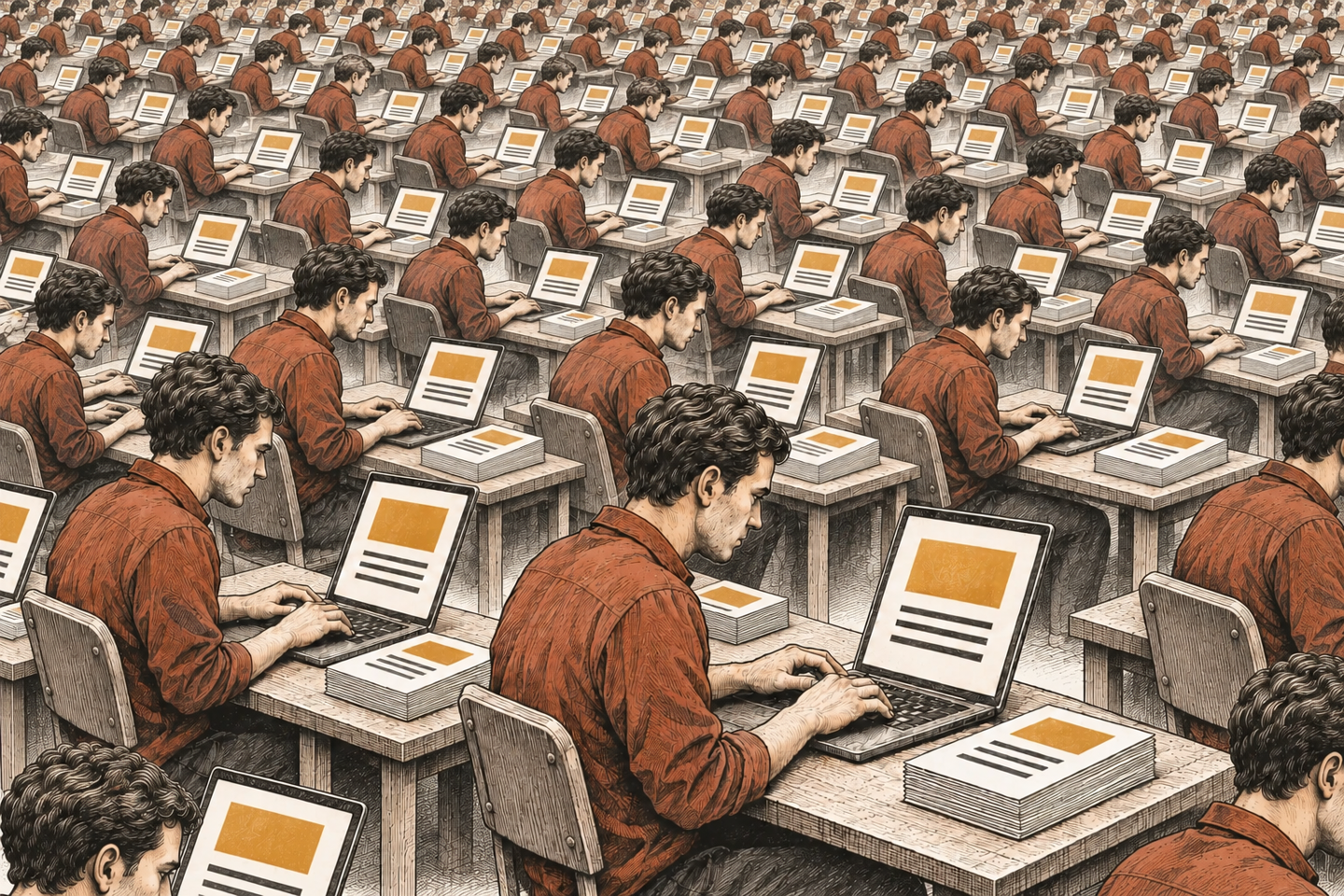
Models are probability machines. They give you something close to the most likely answer, the average of what they learned from. That's useful. But if they're not properly steered and prompted, everything drifts to the middle. Similar tools and similar prompts give you similar results, and every brand starts sounding like every other brand.
And it's not just software development. Across marketing, HR, operations and admin, the rush to bring in agentic workflows risks squeezing out the humanity that makes work feel like it came from a person.
The more businesses lean on AI to make what they make, the more they converge, ending up even more average than capitalism had already demanded.
When every interaction you have with a business is with an agent, people will be crying out for difference, for weirdness, for humanity.
The businesses and operators who can connect, empathise and show they're real are the ones that will win. That's how relationships get built, and relationships are what get good work seen, backed and bought. You don't build them by having an AI talk to customers or colleagues on your behalf. You're certainly not making friends that way. Hand every interaction to an agent and you end up in the middle with everyone else, replaceable and average.
Learning to build with AI gives you more power to act on your ideas. Let it take your judgement, your taste and your relationships too, and you give away the things that made those ideas yours.
Humanity is what breaks you out of the middle.